Climate Change
We build a sustainable future on our journey toward Net-Zero by 2050.
Our Approach
Global warming, abnormal climate, and environmental pollution have already become familiar dangers and realities. Response to climate change is now a social challenge that must be overcome through joint cooperation regardless of government, industry, or individuals. CJ CheilJedang declared Carbon Neutral & Zero Waste for 2050, and is going after sustainable businesses and investments for the future to turn a crisis into an opportunity. We aim to not only pursue business activities for carbon neutrality but also introduce eco-friendly products and technologies that can contribute to carbon neutrality through innovative technology that can be applied by each product unit.
Set Goals for 2030
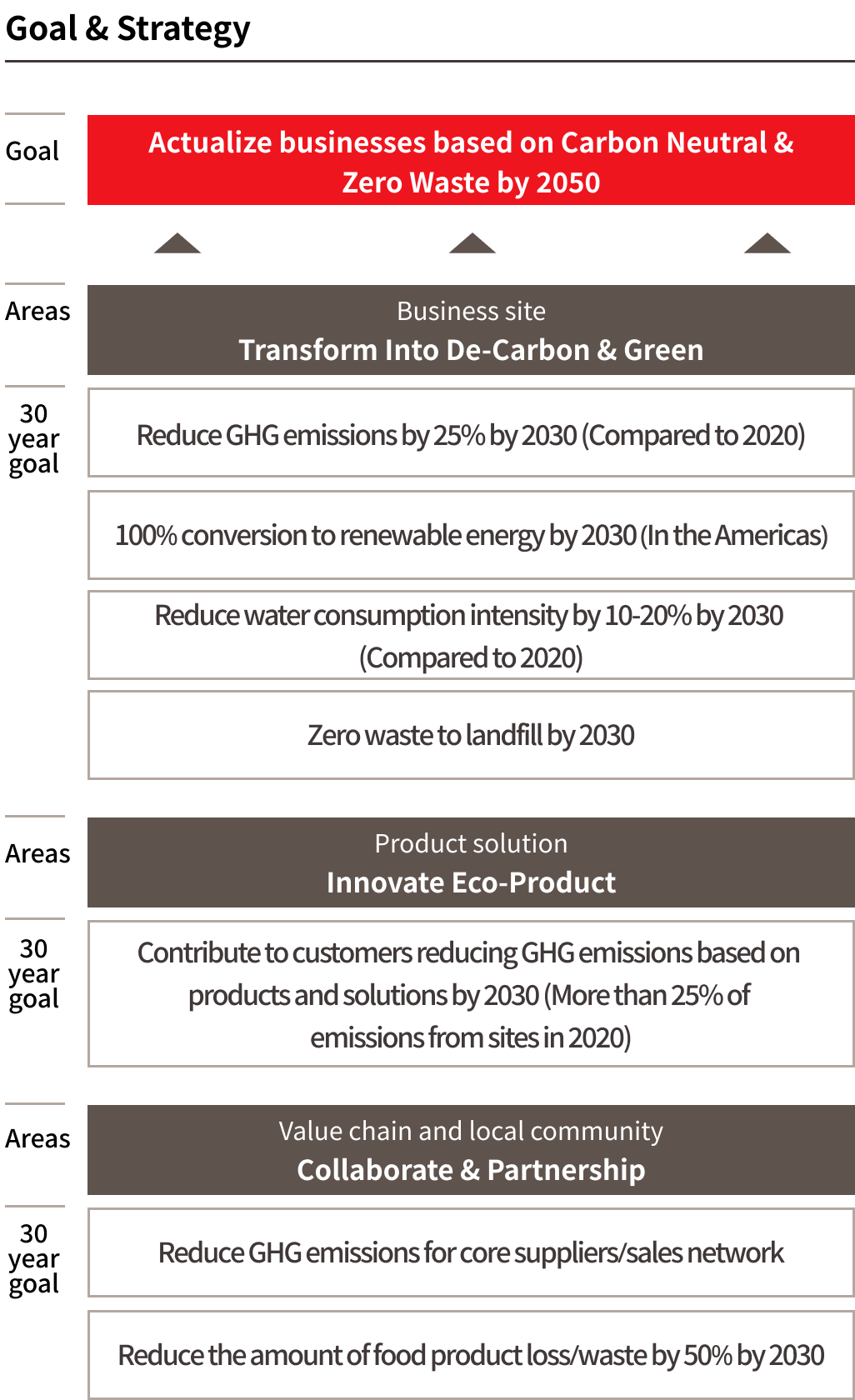
We have established goals for Carbon Neutral & Zero Waste and are pursuing detailed implementation plans. The challenges that we have established include reducing GHG emissions by 25%, reducing food loss and waste by 50%, and from the customers’ perspective, contributing to 25% or more of customers’ GHG emissions reduction based on our products and solutions by 2030 compared to 2020. We have set goals to reduce our environmental impact and are working to continuously improve our environmental performance, and we hope to continue to discover and practice better ways to achieve our carbon-neutral goals.
Pursuing Sustainable Environmental Management
CJ CheilJedang set the "2050 Carbon-Neutral and Zero Waste Business" goal and defined detailed targets for 2030 to minimize negative environmental impacts across all areas of its business sites. These involve corporate-wide innovation ranging from reducing GHG emissions, increasing water efficiency, zeroing waste to landfill, contributing to customer GHG reductions with our products and solutions, the product and solution areas, and minimizing emissions across the value chain from sourcing to sales and disposal.
Environmental Management System
CJ CheilJedang has sustainability governance to accelerate the establishment and implementation of sustainable environmental strategies. The Corporate Sustainability Committee under the Board of Directors is the highest decision-making body that deliberates and makes decisions on environmental management issues, including climate change response. Items to be presented to the committee undergo preliminary discussions at the Corporate Sustainability Council, which consists of the CEO, top executives of each business division, and the head of the ESG organization. As an organization dedicated to corporate-wide climate change response and sustainable environmental management, the Corporate ESG Management regularly identifies laws and regulations related to environmental management, establishes, and implements corporate-wide environmental management strategies including risk identification and analysis, and takes responsibility for effective collaboration and internal and external communication with ESG departments and working- level organizations.
Greenhouse Gas Emissions Management
GHG Emissions (Scopes 1, 2)
In 2021, CJ CheilJedang committed to achieving 2050 Net-Zero to mitigate climate change. To
this end, we aim to reduce GHG emissions from business sites by 25% by 2030 compared to 2020 levels.
We monitor key indicators, such as GHG emissions by operational boundaries (Scopes 1, 2,
and 3) and by country, as well as the GHG emissions intensity relative to production volume.
Since 2022, we have enhanced accuracy and reliability by obtaining third-party verification for GHG emissions and energy usage at major domestic and overseas sites, including manufacturing sites in Indonesia, Vietnam, China, and the United States. In 2023, we introduced an internal carbon pricing system, expanded the installation of renewable energy, replaced outdated refrigeration equipment, and purchased Renewable Energy Certificates (REC) to further reduce GHG emissions. In 2024, while continuing and expanding existing activities, we broadened our analysis of the financial impacts of climate risks and opportunities and developed new crop varieties such as heat-tolerant Napa cabbage to respond to climate change. The Scope 1+2 GHG emissions for 2024 were 2,606 tCO2eq, marking a 23% decrease compared to the previous year.
Other Indirect GHG Emissions (Scope 3)
CJ CheilJedang is building a management framework for other indirect emissions (Scope 3) that
covers the entire value chain, extending beyond GHG management at company business sites.
We have prioritized six out of the fifteen Scope 3 emissions categories companywide, based on their proportion and significance. This is based on the GHG Protocol's Corporate Value Chain Accounting and Reporting Standard, and data were collected with the participation of the Corporate Purchasing, SCM, Environment, and ESG units.
In 2024, Scope 3 emissions totaled 7.575 million tCO2eq. The methodology and emissions calculations were third-party verified by the Korea Standards Association (KSA). Due to the nature of the industry, the largest portion of Scope 3 emissions came from purchased goods and services at 5.991 million tCO2eq (97.1%), followed by fuel- and energy-related activities not included in scope 1 or scope 2 (902 thousand tCO2eq, 11.9%), and upstream transportation and distribution (331 thousand tCO2eq, 4.4%).
Moving forward, we plan to expand the reporting scope by category and continuously refine our activity data and methodologies to achieve even more accurate emissions calculations.
Mitigation and Adaptation Initiatives for Climate Change
Energy Management and Efficiency Improvement at Manufacturing Sites
The Food Business Unit is driving the transition to high-efficiency equipment to improve energy efficiency within its operations. In 2024, the Jincheon Plant replaced outdated refrigeration units and unit coolers with the latest equipment to optimize energy efficiency and reduce electricity consumption. Additionally, Incheon Plant 1 is piloting the Factory Energy Management System (FEMS), analyzing collected data to identify opportunities for further energy efficiency improvements. The BIO Business Unit has introduced the internal system, BMP (BIO Manufacturing Portal), across all global business sites to strengthen energy management systems and monitor energy performance in an integrated manner.
Implementation of the Life Cycle Assessment (LCA)
In 2024, as part of strengthening sustainability management to achieve carbon reduction, the BIO Business Unit established a Life Cycle Assessment (LCA) framework for 41 products manufactured across seven manufacturing sites in five countries. The assessment process underwent third-party validation by the global certification body DNV. This initiative marks the first case in Korea’s food and Green BIO industry where LCA verification was conducted at the site level, rather than for individual products. The evaluation quantitatively measured environmental impacts such as climate change and resource depletion across the cradle-to-gate stages of each product. The verified products included next-generation seasoning ingredients produced through natural fermentation processes and feed-grade amino acids. Notably, the assessment of feed-grade amino acids followed the EU LCA guidelines, ensuring the credibility of the carbon emissions data. Additionally, we developed 'BIOFEED', a program that enables integrated management of feed formulation and carbon footprint, to support our customers in achieving their carbon reduction targets. Moving forward, we will continue to expand the development of low-carbon products and advance our greenhouse gas (GHG) reduction initiatives based on internationally standardized LCA methodologies.
Application of the Internal Carbon Pricing System
To incorporate the financial implications of climate change into investment decision-making, we apply an internal carbon pricing. Internal carbon pricing is factored into both the review and execution stages of investment projects across business units, quantifying potential carbon-related costs and incorporating them into assessments of investment profitability and risk. Investments subject to internal carbon pricing require approval from the relevant business unit's executive leadership and are monitored at the enterprise level to ensure implementation. The carbon prices are primarily determined by referencing the price trends in the Emissions Trading System (ETS) of the relevant investment country. The prices are applied across various investment decisions, including the construction of new plants, capacity expansions, and high-efficiency facility upgrades.
Operation of Global Market Intelligence Room
In response to the increasing frequency of extreme weather events, CJ CheilJedang has recognized the growing importance of climate-related risk management and established a Global Market Intelligence (MI) Room in 2019. The yields of major raw materials such as raw sugar, wheat, soybeans, and corn are highly susceptible to weather conditions, and associated price fluctuations can have a significant impact on business profitability. To mitigate these risks, the MI Room conduct real-time monitoring of crop conditions in major producing regions using global meteorological data provided by institutions such as ECMWF1) and NOAA2), along with key indicators such as El Niño and La Niña. In addition, we conducts AI-based risk management based on a database of extreme weather events and more than 30 years of global meteorological data. Moreover, we have secured dedicated meteorological personnel and established a system for regularly reporting weather trends in key sourcing regions and sharing this information internally, thereby strengthening on-the-ground response capabilities. Looking ahead, we plan to expand the scope of its analysis to localized areas by incorporating data from the Korea Meteorological Administration.
1) European Centre for MediumRange Weather Forecasts
2) National Oceanic and Atmospheric Administration
Climate-Resilient Raw Material Development
Development of Heat-Tolerant Napa Cabbage Cultivar
CJ CheilJedang initiated research in 2018 to proactively address the impacts of climate change, including rising temperatures in highland regions and unstable napa cabbage supply during the summer season. As a result, we successfully developed Korea’s first heat-tolerant napa cabbage cultivar suitable for cultivation in low-altitude areas during the summer. The developed cultivar exhibits stable heading1) even under high temperatures exceeding 25°C, a notable improvement over conventional cultivars that form heads only below 18°C. It also features light green leaves ideal for kimchi production, high yield, and robust root development, making it resilient to climate stressors such as heatwaves, heavy rain, and temporary droughts. These characteristics enable napa cabbage cultivation beyond the geographical limitations of highland farming in summer, supporting a stable supply chain for raw materials even under evolving climate conditions by maintaining both price and quality competitiveness. In 2024, we validated the field performance of the new cultivar and successfully tested its application in kimchi products. Moving forward, we aim to expand the cultivation area and production volume to gradually replace conventional summer napa cabbage supply.
Development of Land-Based Gim Cultivation Technology
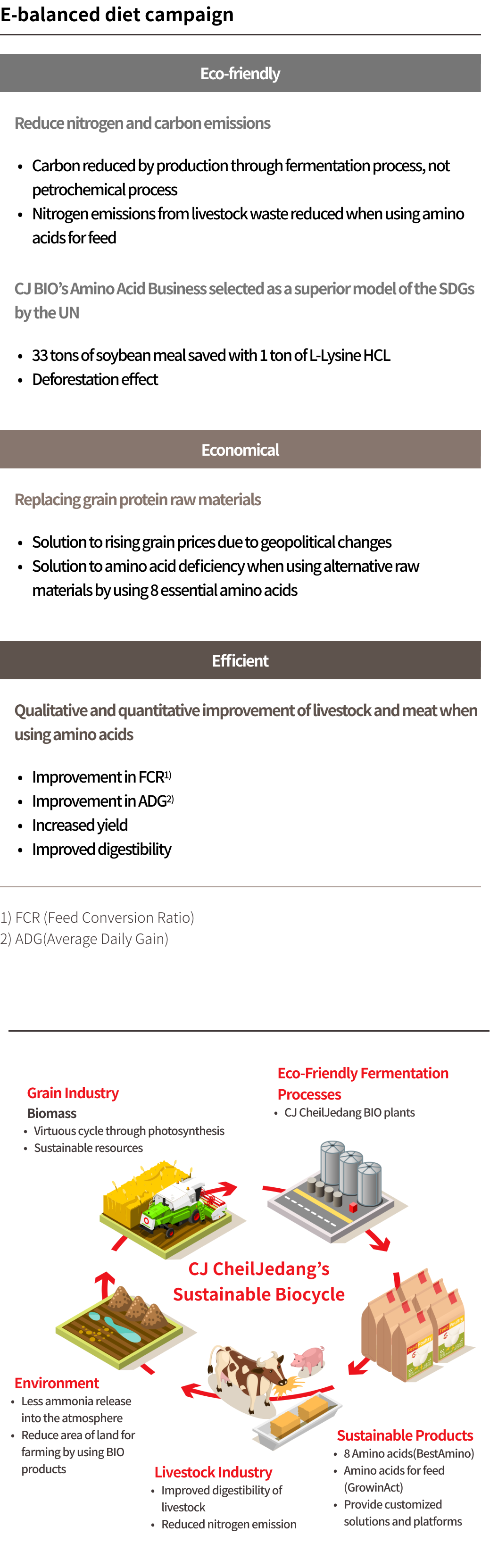
CJ CheilJedang has been developing comprehensive solution to address the deteriorating marine aquaculture environment caused by rising seawater temperatures due to climate change. Since 2018, this initiative has included heat-tolerant gim cultivar optimized for land-based cultivation, as well as related cultivation and processing technologies. The land-based gim cultivar developed by CJ CheilJedang is capable of stable growth in hightemperature conditions, achieving higher yields than conventional gim cultivar under the same conditions. In contrast, conventional cultivars are less heat-tolerant and require energy-intensive cooling processes in land-based systems. We have also built a year-round production system tailored to land-based cultivation, enabling continuous gim cultivation regardless of seasonality. This approach allows for precise control over water temperature and quality, reducing the risk of disease and contamination, and ensuring continuous production even during the summer offseason of traditional marine farming. We are currently focusing on scaling up cultivation operations and enhancing technical advancement, with a target of full commercialization through continuous research and development.
Sustainable Sourcing
Sustainable Palm Oil
CJ CheilJedang recognizes the environmental and social issues associated with palm oil production, such as deforestation, biodiversity loss, and violations to indigenous people's housing rights. In response, we have established the Sustainable Palm Oil Policy, and currently ensure that 100% of the palm oil used domestically is RSPO certified.
We aim to maintain this 100% certification in the future. Our efforts have been recognized, as we received the highest score among domestic companies in the "Palm Oil Buyer Scorecard 2024" conducted by the World Wildlife Fund (WWF), with a total score of 16.2 points. CJ CheilJedang will continue to support a sustainable palm oil industry by adhering to local regulations and international standards in palm oil procurement.
1) RSPO: Roundtable on Sustainable Palm Oil
Sustainable Soybeans
CJ CheilJedang is committed to using sustainably sourced soybeans and increasing its share to manage the potential environmental impacts and human rights issues associated with soybean cultivation. Additionally, we are expanding the gradual use of sustainable soybeans through the acquisition of global certifications such as SSAP1). In 2024, as part of our goal to gradually expand sourcing of sustainable raw materials, we obtained ISCC+2) certification for soybean oil. We plan to continue increasing the proportion of certified soybeans in our procurement.
1) SSAP: Soy Sustainability Assurance Protocol
2) ISCC+: International Sustainability and Carbon Certification